
The first port of our cruise was Rijeka, Croatia (a short distance down the Adriatic Sea from Trieste where we started). When we were in the early planning stages for our cruise and were looking for places to visit and things to do in the area, we had found Postojna Cave and the nearby Predjama Castle just over the Slovenian border with Italy and Croatia. We originally considered renting a car in Venice and staying a night in Slovenia to visit these places, but then decided that since activities in Rijeka were likely to be similar to other ports and Rijeka was reasonably close to Postojna, Slovenia, we would rent a car in Rijeka and make the 1.5 hour drive to Slovenia to visit another country and see these sites in person that looked so fascinating when we were exploring them on the computer at home.
For me personally, one of the highlights was the drive. I've only rented a car in Europe a handful of times and I was always very excited for the prospect of driving some make or model of car that is unavailable here in the U.S. Unfortunately, every time I was stuck with some random Ford or Kia or something else that I would just as likely end up driving in the U.S. I could never even score something common yet European like a Volkswagen. In Rijeka, I was very excited when they pulled out the key and I saw a Renault (French carmaker) logo as there are no Renaults in the U.S.
The car itself (a Megane - an economy hatchback retailing around 20,000 euros depending on options, nothing terribly fancy) was a lot of fun to drive, though the manual transmission was a little tricky in the hills and mountains of the drive.
And those hills and mountains were breathtakingly beautiful. I had heard of Croatia's natural beauty and had put the country on my list because of it, but honestly, I don't think I had ever thought about Slovenia as a vacation destination. I fell in love with the country on the drive as we wound our way through hills and mountains passing small bucolic villages on our way to Postojna Cave.
Since we wouldn't all fit in the same car, Mimi rented a car as well. He got a more crossover-looking Renault - I don't recall the model.

Postojna Cave is a huge cavern complex, over 24 km long, though only 5 km are publicly accessible. The first 3.5 km of that public access area is done in the world's first subterranean cave train (first opened in 1872). Getting in to the train and riding along the first section of the cave, I was reminded of the Seven Dwarfs Mine Train ride in Disneyworld. Here we are on the train in the boarding area.

And here we are inside the cave speeding along (at a leisurely maximum speed of 10 km/hour). It was a great introduction to the cave though it was hard to know which feature to look at as we kept moving.


Getting off the train, we were able to start exploring on foot as long as we more or less kept up with our large guided group. We were particularly struck by the temperature change. Instead of sweating and suffering in the summer heat, we were chilly in the constant 10 degrees Celsius (50 degrees Farenheit) temperature. I found it somewhat refreshing though the kids were huddling for warmth.


I like spelunking through caves like this and marveling at the stalactites and stalagmites thinking about the millions of years it took for them to form. It was really hard to get good pictures in there as using artificial light to see our faces ruined much of the effect of the low lighting on the cave formations, but we did our best.
.jpg)
This stalagmite is huge. The kids were hugging to stay warm.


These draperies hanging from the ceiling look like curtains (hence the name).

Here's our tour group winding down through the cave to get to the bridge where we cross over a chasm. At its deepest, Postojna Cave is 377 feet deep.

Tanja making her way down to the bottom of the public area.


There are some similar caves in our area that we have never taken the kids to, mostly because the tickets are quite expensive, but also because we didn't know that the kids would particularly enjoy them. Other than the kids being cold, they all seemed to enjoy Postojna Cave.


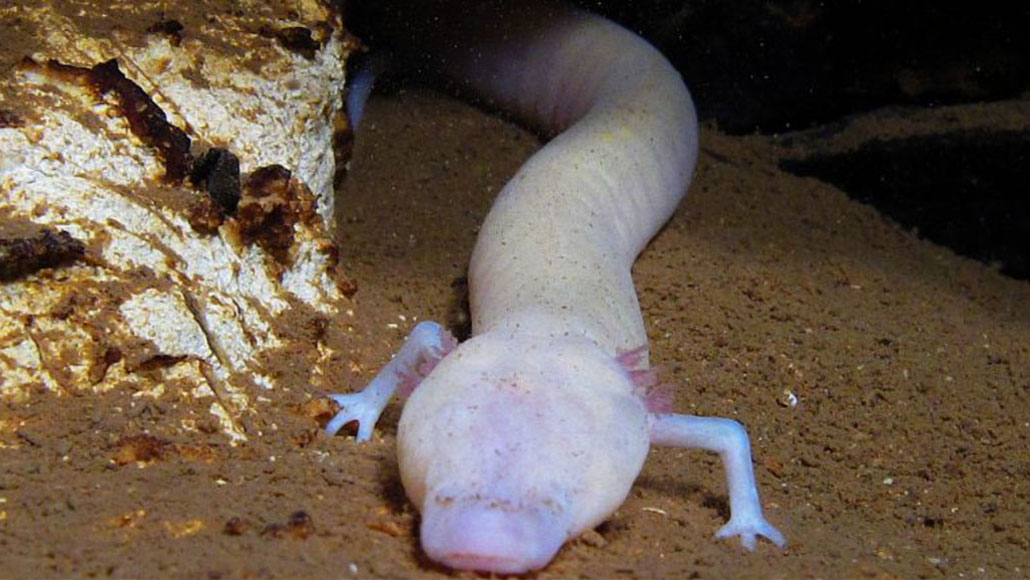
The cave is famous for the olm, a small aquatic salamander that lives there (other names include baby dragon, cave salamander, and human fish) that once identified and categorized by biologists of the time even attracted the attention of Charles Darwin. On the way out, we got to peek inside an aquarium that housed a few - because they were so light sensitive, we weren't allowed to take pictures of them, but it was interesting to see such a strange looking species. Here's a picture of one from Science News:
We also browsed through the gift shop/fully functioning underground cave post office.
After we finished with Postojna Cave, we went to visit nearby Predjama Castle. While a castle (or at least fortifications) has existed on this spot at least since 1274, the current castle dates to 1567 when it was rebuilt after being destroyed by an earthquake in 1511. The castle is perched on a 123 meter high cliff and backs into a cave system that served as a source for protection, escape routes, cooling, and water.


We had a self-guided audio tour of the castle where we learned about the history and the innovations they used like collecting the water dripping from the stalactites into cisterns for their own use and using the climate controlled cave to hold food in a Renaissance-style refrigerator. Here's a picture from inside the cave portion of the castle looking out through a natural hole in the cave opening to the town below. The paneled triangular shape shining to the left of the opening is a collection system for water - it catches the water dripping from the ceiling and sends it down a series of pipes to the cistern within the castle.

We learned about the robber baron, Lord Erasmus/Erazem of Lueg. I believe it was him (though it might have been a different lord of the castle) who ordered the forest up to a certain distance around the castle to be cut down of all trees. That way, should any enemies try to attack the castle from the only exposed side (since the back was against the cliff face and opened up into the cave system), they would have no cover and could easily be seen and countered by the guards and archers on the castle wall. Here's Karina looking out over the valley that now has trees, but would not have hundreds of years ago.

Erasmus was something of a Slovenian Robin Hood. As the son of the imperial governor of Trieste (where we started our cruise), he killed the commander of a rival imperial army (the Habsburgs) over an insult against one of Erasmus's deceased friends. Erasmus fled from the Habsburgs and holed up in his family castle in Predjama which was easily defended. He then began to attack Habsburg estates and towns, plundering them and bringing the riches back to Predjama where he shared with his people. The Habsburgs laid siege to the castle for over a year, but Erasmus was able to go in and out as he pleased through a secret tunnel through the cave behind the castle that emptied out. He allegedly would gather baskets of fresh strawberries from area farms on his night shopping runs through the cave tunnel and taunt the starving army besieging the castle.
Here I am in the publicly accessible part of the tunnel Erasmus used within the cave portion of the castle.

After over a year of the siege, one of his own men betrayed him according to legend. As Erasmus was making use of his private outhouse one night which sat on the edge of the cliff, his man who had been bribed hung a lantern outside the outhouse (the pre-arranged signal) and the army fired a well-aimed cannonball into his lavatory while he presumably was sitting on the toilet. A rather humorous way to go if you ask me. I told Derek the story when I heard it and pointed out the outhouse where it happened and he started laughing about the knight who was killed while going potty. Here's Derek inside the castle (possibly outside the infamous outhouse).

On the drive back to Rijeka to get on the cruise ship, we had a bit of an interesting adventure. For one thing, in Slovenia, the largest and fastest highways require a toll pass that we didn't purchase, so we had to purposely avoid accidentally getting on one of those highways (though the only one in the area that we could have gone on was going the wrong direction so it's not like we were adding extra time by avoiding these roads). The bigger issue was that our downloaded maps of the area on our phone GPS had us taking increasingly smaller roads. I was fine with that and we trusted blindly in the GPS while enjoying the drive through idyllic farmland and occasional small villages nestled against the foothills of larger mountains in the distance. We kept passing turnoffs with signs that directed us to turn onto them to go to Rijeka, but the GPS kept insisting we continue on its route. I'm fairly confident Mimi and Mormor behind us were thinking that we were completely lost. When we followed the GPS onto a narrow dirt road through a forested area (looked like a logging road) that was heading over a large hill/small mountain, I thought our little hatchback was not likely to do well on the rough road, and so we gave up following the GPS and turned around. Tanja navigated us back to something closer to civilization and once we crossed the Croatian border we didn't have to worry about tolls any longer so we jumped on a larger highway and made our way back successfully to Rijeka. I should note that the GPS was still insisting we do a U-turn and go back to the logging road for miles after we got on the actual highway to Rijeka.

No comments:
Post a Comment