
We next toured the city of Wells. We went to the Bishop's Palace, home to the Bishop of Bath and Wells since the 13th century.

The palace is surrounded by fortress walls and a moat. This bridge was originally a drawbridge to cross the moat. A 14th century bishop had the walls built for his own defense and protection due to him imposing taxes on the citizens of Wells while perhaps living in relative luxury within his palace. The moat was fed by springs within the palace area (the springs were the namesake for the city of Wells) and served as water supply for the city as well as a drainage system to make the area less marshy.

The moat has swans swimming around.

While symbols of peace and tranquility, swans can actually be quite aggressive. Fortunately none of them attacked us while we were there.

Inside the walls of the Bishop's Palace is a nice courtyard, a handful of cafes and other shops for the tourists, and the home of the Bishop. We enjoyed wandering around the walls and looking around. In writing of this blog post, I learned it was also the filming location for scenes involving the French prison for the show Poldark that Tanja and I had watched and was at least partially responsible for us choosing this England trip because of the stunning scenery.

At around 12,000 people, Wells is still considered a city because it has a cathedral, so it holds the title of the smallest city in England (though in a fun bit of trivia, strictly speaking, the one square mile City of London which only consists of the small downtown district mostly full of office buildings is actually the smallest city in England in both population and land area). The cathedral itself was built in many stages between 1176 and around 1490.


The statue work along the tower is impressive, though the lower niches are conspicuously empty. The statues there had been removed over the years by various groups for various reasons ranging from war to reformation. I like to think that the people doing the removing didn't feel like building the scaffolding necessary to get up to the higher statues.

The interior of the cathedral is noted for the so-called "scissor arches". These hourglass shaped double arches were added around 1340 to provide more support for the sagging tower.


An abbey church was built in Wells in 705. The font below was part of that abbey church and is the oldest part of the current cathedral.

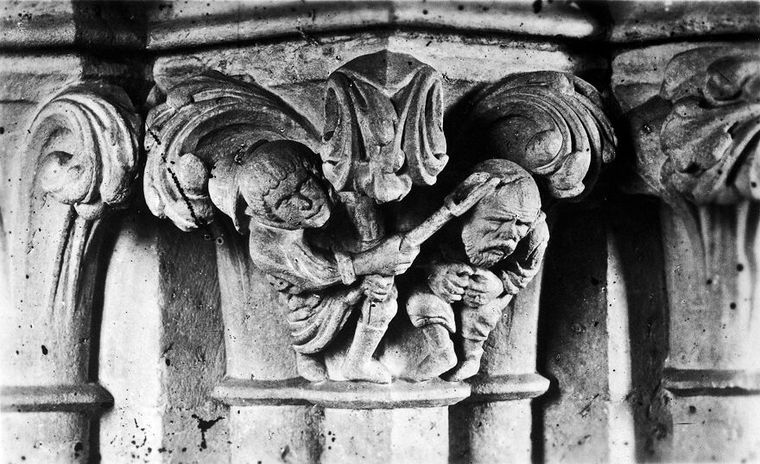
There are several statues carved into columns throughout the church depicting various scenes like a man with a toothache, a peasant pulling a thorn out of his foot, and a so-called "Wages of Sin" series of carvings around a column with thieving peasants stealing fruit from an orchard and the farmer eventually tracking them down and clubbing them over the head.

Just outside one of the walls of the cathedral is the Vicar's Close. This dead-end street dates to the 14th century (construction ranged from 1348-1430) and the homes built along it were built for the choir members for the cathedral. The choir at the time had duties to chant divine services eight times daily and it was apparently problematic to have them making that commute from throughout the city so many times. The Vicar's Close is believed to be the oldest residential street in Europe with the original buildings still intact. People still live in these historic homes, though they have been upgraded substantially since their original construction.
The cobblestone street is designed with an optical illusion. As you go toward the cathedral, the road gets progressively narrower making the street seem much longer than the roughly 460 feet it really is.

At the end of Vicar's Close is the Vicar's Chapel and Library.
.jpeg)
After Wells, we went to Glastonbury. Our first spot was the Glastonbury Abbey ruins. The monastery here was founded in the 8th century though a fire in 1184 destroyed it. It was rebuilt and became one of the richest and most powerful monasteries in England. Then it was dissolved as part of the Dissolution of Monasteries under King Henry VIII. Between 1536 and 1541, the number of monasteries, nunneries, and friaries in England went from over 850 to 0. This was done as England moved away from Catholicism to become Protestant during the Reformation, and the wealth of the Catholic Church properties was absorbed by the English Crown. Possibly because of the particular wealth of Glastonbury Abbey or the vigor with which the abbey leaders opposed the dissolution, Henry VIII may have wanted to make a particular example of Glastonbury Abbey and he had it completely destroyed and had the abbot violently executed.

Of course, I very much enjoyed wandering around the ruins, even when it started to rain.


Glastonbury is inextricably linked with King Arthur, as the legend holds that the island of Avalon where Arthur got his sword Excalibur from the Lady in the Lake was Glastonbury Tor, the large hill near the town (back then the water in the marshy area was much higher due to not having the drainage systems used today). After the fire in 1184 had destroyed the monastic buildings here at the Abbey, they immediately began to rebuild. Rebuilding is expensive and they needed more money which was a problem because the number of pilgrims visiting had dropped dramatically. The abbot was inspired to commission a search of the property around the abbey. "Miraculously," a hollowed out tree trunk was found buried on the property and inside the trunk were skeletons of a male and a female. A lead cross was found over the covering stone for the tree trunk tomb with the inscription Hic jacet sepultus inclitus rex Arturius in insula Avalonia ("Here lies interred the famous King Arthur on the Isle of Avalon"), though different historians have slightly different variations of the inscription.
The groundbreaking discovery of King Arthur and Guinevere's tomb in Glastonbury/Avalon provided new inspiration for pilgrims and as word spread, the pilgrims came to fill the coffers of Glastonbury Abbey and allow it to rebuild completely. It was most likely a fantastically successful publicity stunt rather than solid archeology, but I'll admit that part of me wants to believe. Here's the site of where King Arthur and Guinevere's Tomb was within the abbey once they built something more impressive than the tree trunk to house the remains.

I made a pilgrimage to Chalice Well Gardens. The well here has been in almost constant use for over 2000 years. Celtic mythology links wells to being gateways to the spirit world and this well in particular holds interest for some Christians as well. Early Christian mythology holds that Jesus's uncle, Joseph of Arimathea, laid the chalice that caught drops of Christ's blood at the crucifixion at the bottom of the well. It's at least plausible that Joseph, who was a trader, was in this area as tin from mines in the area was a widely traded commodity that reached the Holy Land in those days. This Holy Grail and the blood within it supposedly made the spring water occasionally run red as well as being slightly warmer than the surrounding ground temperature. In winter, roses close to the well supposedly bloom whereas flowers further away do not. Scientifically, there are iron deposits that cause the coloration of the water, but it does make for a good story.
The gardens are full of pools fed by the spring and many flowers. While the spiritual pilgrimages over the centuries ranged from Celts to Christians on a Grail quest, now this is a site more for New Age spirituality. Features like this terraced pool make it a very peaceful spot.

This lion's head fountain offers visitors the chance to drink the spring water and fill up their water bottles.

The Chalice Well itself was decorated with many flowers.

Outside the Chalice Well Gardens was another spring known as the White Spring that is used for spiritual worship for some of the New Age hippie types that frequent Glastonbury. Tanja and the kids were wandering in the alley and saw many merchants selling various implements for worship (talismans, crystals, jewelry, charms, etc.) There was a fountain to fill up their cups with holy water from the spring. Inside the White Spring building people were chanting, singing, and worshiping with candles in the dark room (where at least some of the worshipers were naked). Here's Karina outside the White Spring.

Towering over the town of Glastonbury is Glastonbury Tor (in the distance behind Lydia).

The 500 foot hill offers great views of the countryside for those who hike up to the top of it.

The hike to the top took about half an hour.

At the top of the Tor standing as a beacon lies the ruins of St. Michael's Church. This church was built out of sandstone in the 14th century to replace an earlier church also dedicated to St. Micheal that was destroyed in an earthquake. Since St. Michael was the Christian antidote to paganism, it is likely that the church was built on a pre-Christian religious site.

The views were worth the climb.

A young girl had apparently purchased a bag of rocks from one of the merchants down below at the White Spring and the merchant told her they were lucky rocks and she should go find people to share them with. She offered Karina one of the rocks and Karina was happy to have her own lucky rock.

We found ladybugs on the hill and Lydia got them to crawl onto her hand.


Looking out from the top of the hill, I tried to envision it as the island Avalon in King Arthur's time. I couldn't clearly picture the area underwater, but I did enjoy the feeling of being on top of the countryside.

Glastonbury hosts a huge music festival every summer and we fortunately got there a few days before the crowds showed up. The festival (and the types of people that live there) seem to me like this town was what Woodstock would have been had it turned into a yearly gathering. All the DJs on the radio stations were talking about their plans for the festival, so it is a big deal. Jokes about Glastonbury say it is a town that provides hundreds of places to buy crystals or get your auras read but leaves you scrambling if you need to buy some basic item like toilet paper. The murals gave yet another indication of the types of people who lived in Glastonbury. I can't deny their artistic skills.


Hiking around wore the kids out that day.

When we got back to the inn for the evening, we went for another walk to go to Trebarwith Beach. Karina's shoes weren't waterproof so I gave her a piggyback ride across a stream we had to cross.

The beach was a nice place to visit.


No comments:
Post a Comment